
Fundamentals of Lasers
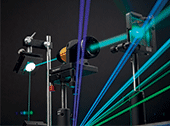
How Do They Work?
The basic structure of any laser is based on an active medium (either a gas or semiconductor) contained between two reflectors. A laser's reflectors contain light by oscillating it through a medium repeatedly allowing the energy to build up with each pass. Laser radiation escapes due to a partially reflecting mirror in the assembly. This light can be used for a variety of applications.
Elements of a Laser
Beam Size: The beam size refers to the diameter of the laser beam, measured at the exit face of the laser housing. See Figure 1.
Beam Divergence: The beam divergence is the specification that defines how much the beam spreads out over distance. Beam divergence is defined by the full angle. In diodes beam divergence is specified with two values because of the presence of astigmatism (see Diodes vs. HeNe).

Fan Angle: The angle produced by accessory line or pattern generators. See Figure 2.
Output Power: The output power specified is the maximum power value of the laser light after the beam exits the laser housing; in other words, power is rated after passing through (but not before) any optics. Values stated are typically within +/-10%. The light intensity has a Gaussian profile meaning it is highest at the center of the beam and dissipates outwards.
Class: This is the CDRH (Center for Devices and Radiological Health) warning label required on all laser products. The class designation (II, IIIa, or IIIb) corresponds to the maximum amount of laser radiation emitted from the laser at a specific wavelength.
Detectability/Visibility: The visibility of the laser spot (when viewed by your eye or another detector) depends on the signal to noise ratio (SNR). SNR is the ratio of signal power (laser energy) to the noise (background non-laser illumination). Higher SNR means that the laser spot is more detectable. For visual applications, keep in mind that the closer to 550nm (green) the laser wavelength is, the brighter it will appear. In detector applications, use filtering to increase your SNR and perhaps utilize a lens to limit field of view. Laser wavelengths should also be selected to best match a detector's responsivity.
Lifetime: Power supplies should be selected to run at the lowest voltage possible to extend lifetime. Heat sinks are recommended and must be used if operating near maximum voltages. Maintaining a diode at the low end of the operating temperature range can also extend the lifetime. Diode modules typically have a lifetime of 10,000 to 20,000 hours compared to the 100,000-hour typical lifetime of the diode component.

Figure 1: Laser Diode

Figure 2: Laser Diode Module
Laser Accessories
Pattern Generators: Lasers inherently have a Gaussian profile (see Output Power). Conventional refractive optics, such as cylinder lenses, do not correct for this although some techniques can be used to obtain very good performance with refractive optics. Diffractive optics can reduce the often cumbersome Gaussian profile of line generators (see Figure 2).
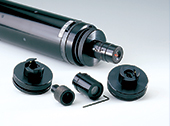
Spatial Filters: These are designed to "clean up" the laser beam by filtering out multiple-order energy. The resulting beam intensity still has a Gaussian profile.
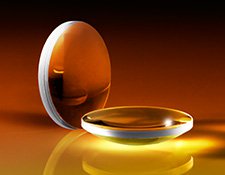
Laser Optics: With higher-powered lasers, it is important to consider laser optics (lenses and mirrors). Optics with lower surface quality may be damaged by internal focusing of the laser beam.
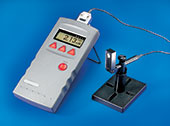
Laser Measurement Devices: A variety of power meters, viewers, detector cards, and other means of characterizing your laser are available in our catalog.
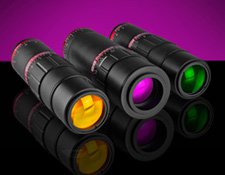
Beam Expanders: These are designed to provide larger diameter collimated beams and can also be used to decrease spot size at large distances.
Mounting and Positioning Laser Diodes
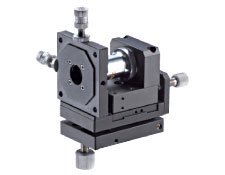
Mounting Options: There are several options for mounting and positioning lasers. Diodes can be held using our Diode Mount, which is convenient because it offers a ball and socket aiming adjustment and adapts to ¼-20 threading. However, diodes can also be held in our V-mount blocks, which are traditionally used for HeNe lasers. Our twin-ring Laser Holders can also be used for HeNe cylindrical lasers. The laser should be heat sinked whenever possible (especially since most diodes are temperature-sensitive).
Alignment and Positioning: All lasers inherently have an associated tolerance for alignment (pointing) accuracy. Pointing accuracy is a measure of the angular difference between the propagating axis (where the laser light is pointing) and the mechanical axis (where the housing is pointing). Make sure that the mount has the adjustment to take some of those tolerances into consideration.
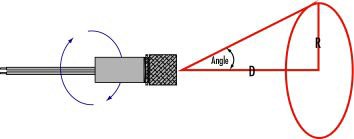
Note: To measure the pointing accuracy of your laser, simply spin the housing (this is best attempted on a V-block of some sort). The spot will trace a circle at a certain distance. By measuring the distance D and radius R (see illustration), we can calculate the angle of the pointing error. Simply mount the housing at that angle to insure that the laser propagation is accuray aligned.
Laser Diodes vs. Helium Neon Lasers
"When is a HeNe more suitable than a diode or vice-versa?" The answer to this question is application dependant. The easiest way to make an informed decision is to understand the advantages and disadvantages of each type of laser, based on your needs. The following table offers a comparison of typical specifications and property characteristics of the lasers we offer.
111 | Helium-Neon | Diode |
Common Wavelengths | 543nm, 594nm, 612nm, 632nm | 532nm, 635nm, 670nm, 780nm, 830nm |
Size (housing) | Large, replacement is difficult | Compact, replacement/repair is easy |
Beam Size | ~0.5-1mm (circular) | ~4 x 1mm (astigmatic/elliptical) |
Output Power | 0.25-30mW (min. values stated) | 1-25mW, some modulated (max. values stated) |
Beam Divergence | ~1-2mrad (circular) | ~0.5 x 1mrad (astigmatic/elliptical) |
Power Modulation/Pulsing | Modulated power uncommon | Several specialty versions are available |
Power Stability/Noise | Stable versions available | Typically noisy |
Cost | High cost (long lifetime) | Low cost (usually easily replaceable) |
Lifetime | 10-40,000 hrs (depending on type) | 10-20,000 hrs (depending on type) |
Sensitivity to Environment | Not typically temperature sensitive | Wavelength/lifetime changes slightly with temperature (use heat sinks) |
Accessories Available | Pattern Generator (refractive/defractive), Beam Expanders, and many more. Many accessories are interchangeable with bezel adapter. | Focusing, Pattern Generator (refractive/defractive), and many more. Interchangeability is typically limited to the diode's original configuration. |
Astigmatism: Divergence difference for the x and y axis | Yields circular spot when focused, and the spot blurs symmetrically in and out from focus | Yields circular spot when focused and the spot blurs elliptically (orthogonal orientation in and out from best focus) |
Coherence Length: | Long coherence length (~2-3m) | Short coherence length (a few millimeters) |
Polarization: | Available in random and linear polarization | Most are highly polarized |
Integration | Easy to plug in; power supply included | Many come with wire leads (optional power supplies are available) |
Typical Applications | Holography, Interferometry, Metrology | Alignment, Machine Vision, Scanning, Sensing (go/no-go) |
版權所有 © 2026 江陰韻翔光電技術有限公司 備案號:蘇ICP備16003332號-1 技術支持:化工儀器網 管理登陸 GoogleSitemap


